The global cat litter market reaches $18.1 billion in 2026 and is projected to hit $26.4 billion by 2033 (5.5% CAGR). But the headline number hides the real story: the market is restructuring around three forces — plant-based materials (7.6% CAGR), private label expansion (18-26% volume share), and e-commerce channels (35-55% penetration). This report decodes the data that matters for brand owners planning their next move.
- Market size, growth, and regional breakdown (NA / EU / APAC)
- Why plant-based litter grows 38% faster than the market
- How private label is quietly eating national-brand share
- Three proven brand-launch strategies for 2026 — with price points and channels
In This Report
01Global Market Overview — $18.1B and Growing
The global cat litter market will be worth an estimated $18.1 billion in 2026, up from $17.2 billion in 2025, according to Grand View Research. Their forecast puts the market at $26.4 billion by 2033 — a 5.5% compound annual growth rate.
That growth, however, is not evenly distributed. Three shifts matter most for anyone planning a product line or brand launch this year:
- Material shift — Clay (bentonite) still accounts for 81.6% of raw material volume, but plant-based alternatives are growing nearly 40% faster than the market as a whole.
- Channel shift — In premium US segments such as crystal litter, e-commerce already handles 35-45% of sales; in China, online channels exceed 55%. Traditional retail continues to cede ground to DTC brands and subscription models.
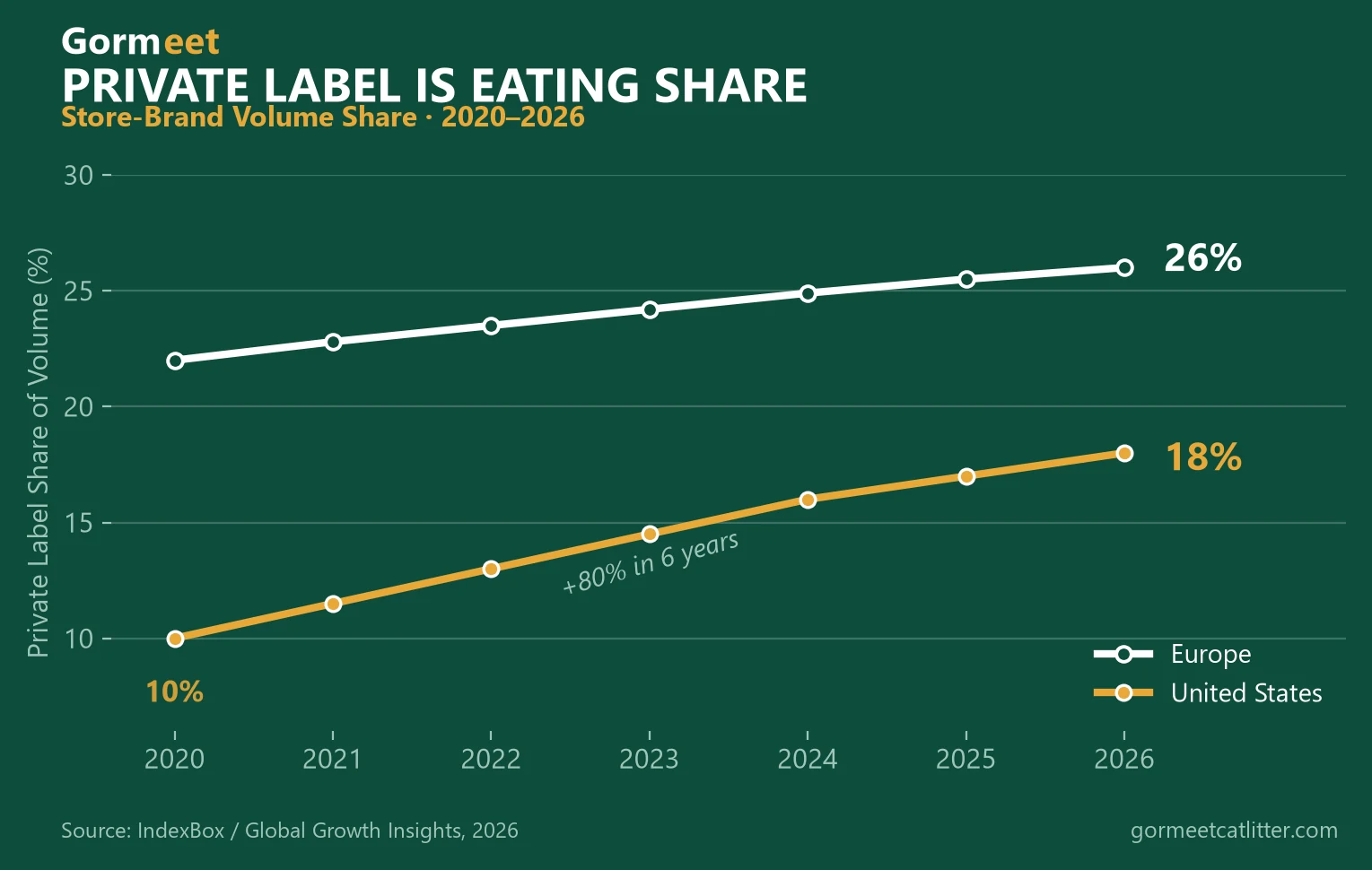
- Brand shift — Private label now holds 15-20% of US unit volume (up from roughly 10% in 2020) and 26% in Europe, as retailers expand their own-brand programs.
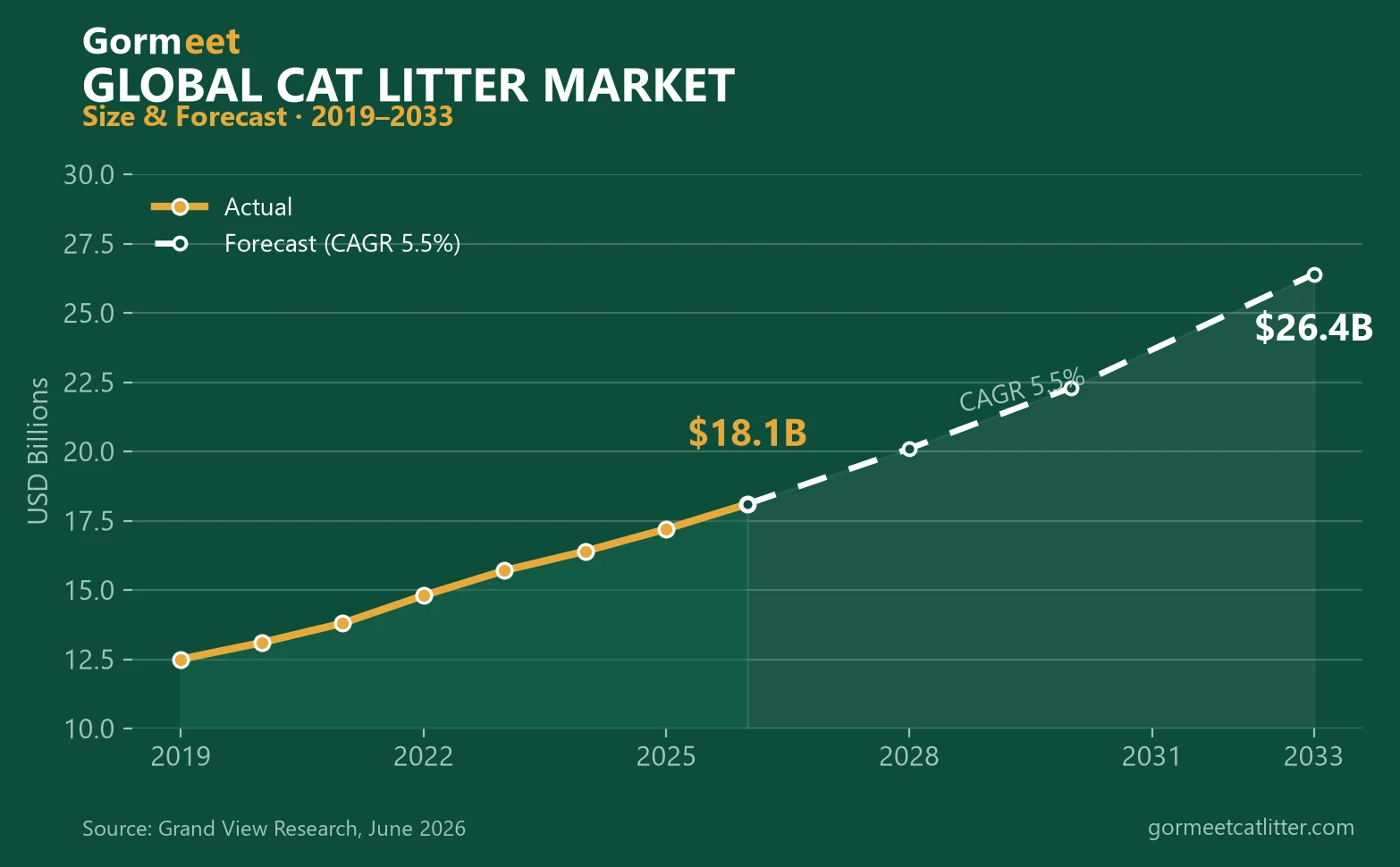
A note on reading these numbers: A 5.5% CAGR looks modest on its own. What matters is where the growth concentrates. Plant-based materials, e-commerce, and private label are each expanding at two to three times the market rate. A new brand built around conventional clay litter sold through conventional retail enters the slowest-moving part of the market; a brand built around the growth segments starts with the wind behind it.
"Plant-based litter is growing nearly 40% faster than the market as a whole.— Research and Markets, 2026
02Regional Deep-Dive: Where the Money Is
The global cat litter market is not one market — it is three major markets with different drivers, consumer preferences, and entry strategies.
North America — Largest and Most Mature
North America remains the largest cat litter market in the world. The US accounts for the majority of it, driven by high per-capita pet spending and an entrenched culture of pet humanization.
- Clumping dominance: 75%+ of volume is clumping litter. Non-clumping is a niche.
- E-commerce surge: 35-45% of crystal-litter sales now happen online; DTC subscription brands (e.g. PrettyLitter) have proven the model at scale.
- Private label growth: Store brands now capture 15-20% of unit volume, up from ~10% in 2020. Amazon's own-brand expansion is accelerating this.
- Premiumization: Premium and super-premium segments account for roughly half of market value despite representing less than 20% of volume. Consumers pay for performance, not just price.
- Concentrated competition: Nestlé (Purina) and Clorox (Fresh Step) hold approximately 18% and 14% market share respectively — mass-market clay is a fortress.
For brands entering this market
Targeting the US? Go premium, go online, or go private label — ideally two of three. Competing with Purina and Fresh Step on price in mass-market clay is a losing game. The realistic entry points: (1) premium plant-based DTC brand, (2) Amazon FBA private label, (3) specialty-retail store brand. Each demands a different product spec, packaging strategy, and price point.
Europe — Sustainability-Driven and Regulation-Heavy
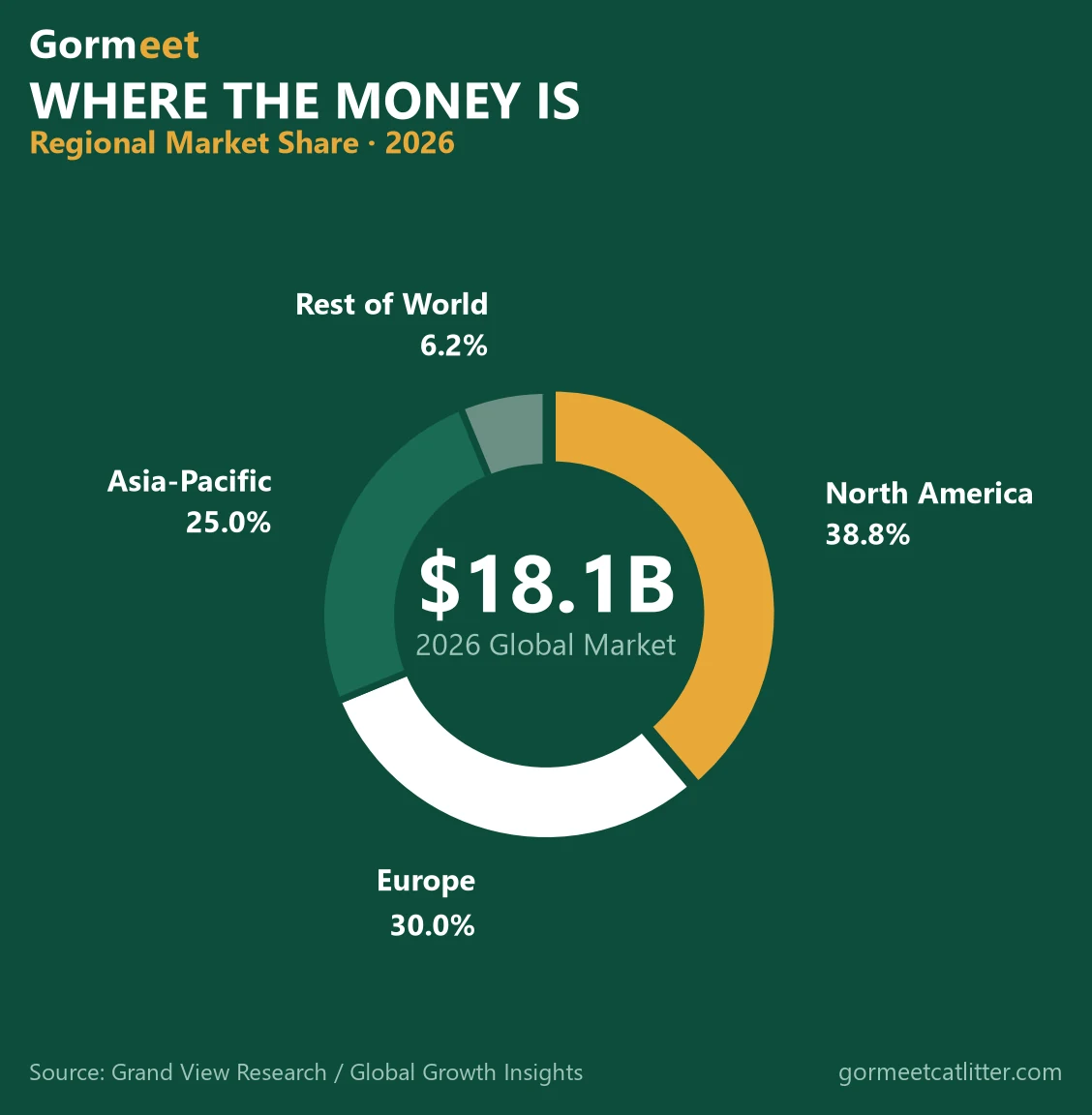
Europe is the second-largest market at approximately $5.4 billion in 2026. What makes Europe unique is its regulatory environment — simultaneously the most challenging and the most rewarding market for sustainable brands.
- Private label leadership: 26% of European cat litter sales are private label — the highest rate globally. Retailers like dm, Rossmann, and Aldi run sophisticated store-brand programs.
- Sustainability mandate: Biodegradable litter penetration stands near 34% (vs ~25% globally). Packaging regulations (Germany's VerpackG, EU-wide Extended Producer Responsibility) are forcing material redesign.
- Low-dust preference: 61% of European consumers prefer low-dust litter — the highest rate globally — driving demand for plant-based and silica alternatives.
- Subscription culture: 29% of European buyers purchase via subscription — significantly higher than North America — favoring brands built for recurring revenue.
- Compliance moat: EU REACH, VerpackG, EN 13432 compostability, and country-specific labeling laws raise the entry bar. Brands that clear these hurdles face materially less competition.
For brands entering this market
Europe is where sustainability credentials convert directly into shelf space and margin. If your brand can check the boxes — plant-based formulation, recyclable mono-material packaging, complete EU documentation — you can command premium pricing in a market that actively rewards these attributes. Germany is the gateway: the largest EU economy, the strictest regulations, and the highest willingness to pay for certified products. Win Germany, and the rest of the EU follows.
Asia-Pacific — Fastest Growing and Most Complex
Asia-Pacific generates approximately $4.5 billion in 2026 and is the fastest-growing region. It is also the most fragmented — China, Japan, South Korea, Southeast Asia, and Australia each have distinct consumer behaviors and channels.
- Plant-based leadership: APAC is where tofu cat litter was born and where it is most mainstream. In China, plant-based formulations are growing at 14-18% CAGR — nearly triple the global rate.
- E-commerce dominance: 55%+ of cat litter sales in China happen online. Tmall, JD.com, and Douyin have made DTC the default distribution model.
- Price segmentation: Three clear tiers — value (RMB 1-1.5/kg), mainstream (RMB 2.5-4/kg), premium natural (RMB 6-12/kg) — each with different material preferences and brand expectations.
- Kitten-specific demand: The "fur baby" culture drives demand for ultra-low-dust, unscented, ingestible-safe formulas — a subsegment growing at 10-12% annually.
- Innovation velocity: New product cycles in APAC run 2-3x faster than in Western markets. Brands that cannot keep pace with formulation trends lose relevance quickly.
For brands entering this market
APAC is simultaneously the most competitive and the most innovative market. Western brands entering APAC need local partnerships — the distribution landscape is too fragmented for direct entry. APAC brands exporting westward hold a genuine edge: deep formulation expertise in plant-based litter, precisely the category now entering its growth phase in North America and Europe.
03Material Trends: The Plant-Based Revolution
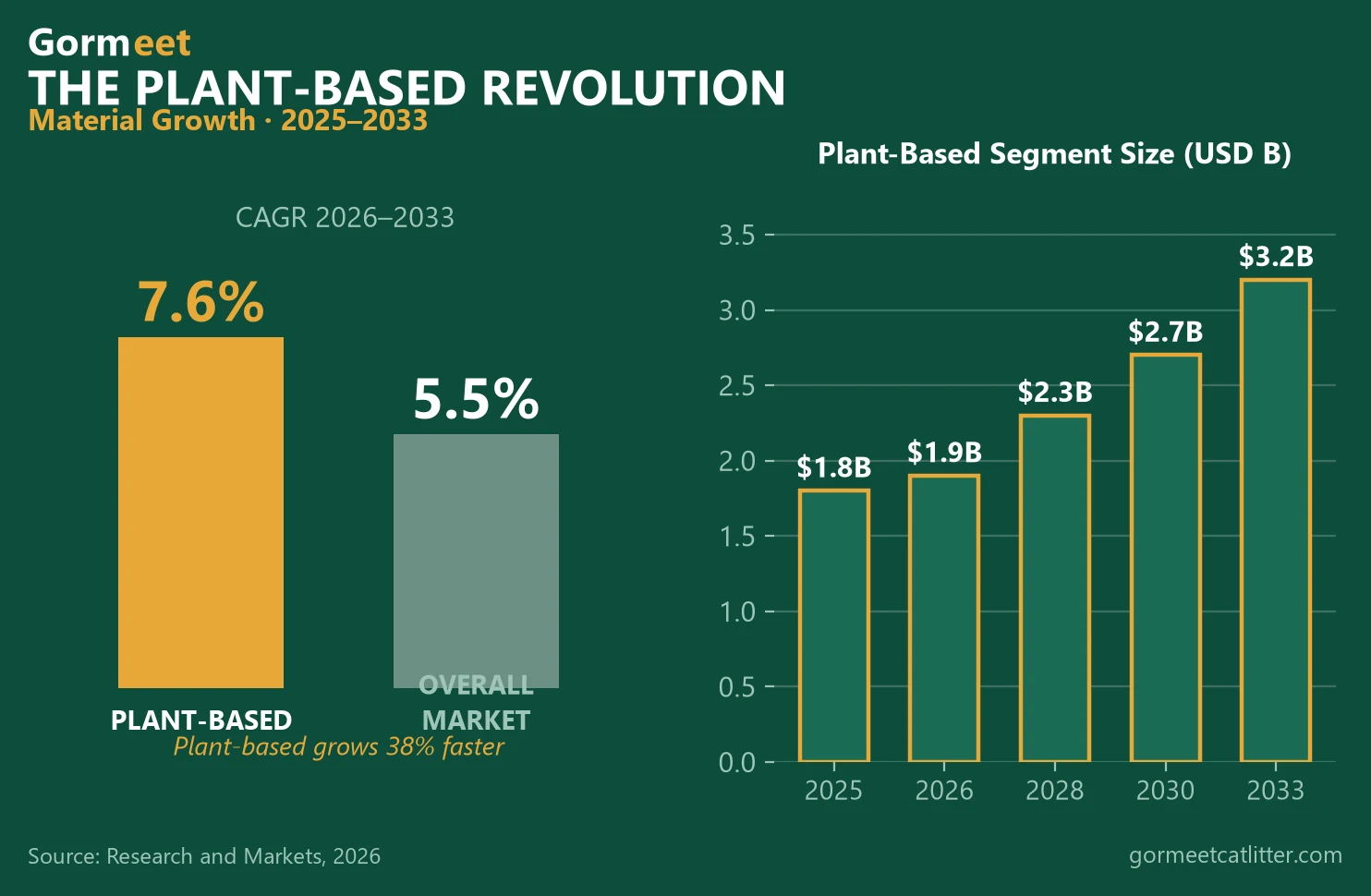
Clay (bentonite) has dominated cat litter for decades and still commanded 81.6% of raw-material share in 2025. But the growth story is elsewhere.
Plant-based cat litter — made from pea fiber (tofu), cassava, corn, wheat, wood, and recycled paper — is the fastest-growing segment in the industry. The natural cat litter sub-market alone was valued at $1.8 billion in 2025 and is growing at 7.6% CAGR, roughly 38% faster than the overall market.
Why Plant-Based Is Winning
Four converging forces are driving the shift from clay to plant-based:
| Driver | What Is Happening | Impact on Material Choice |
|---|---|---|
| Environmental Awareness | Sustainable litter adoption has reached ~38% globally. EU regulations (VerpackG, SUP Directive) accelerate the shift. | Brands need biodegradable or compostable formulations to keep shelf access in Europe. |
| Health & Safety | Sodium bentonite mining raises environmental concerns; clay dust is a respiratory irritant for cats and owners. | Low-dust and dust-free formulations are becoming table stakes, not premium features. |
| Flushability Demand | Urban apartment dwellers want flushable litter. Clay cannot be flushed; tofu and cassava can. | Flushability is the #1 purchase driver for plant-based litter in dense urban markets (Tokyo, Seoul, NYC, London). |
| Generational Shift | Cat ownership grew 18% among Gen Z and 24% among millennial men in 2024 (APPA). These cohorts treat litter choice as a values statement. | The customer base is shifting toward buyers willing to pay 2-3x for sustainable products. |
Material Performance Comparison
Not all plant-based litters are equal. Each material has distinct performance characteristics that determine which brands and markets it fits:
| Material | Clumping | Dust | Odor Control | Flushable | Cost | Best For |
|---|---|---|---|---|---|---|
| Tofu (Pea Fiber) | ★★★★ | Very Low | ★★★★ | ✅ Yes | $$ | Premium eco brands, urban markets, flushable positioning |
| Cassava | ★★★★★ | Very Low | ★★★★ | ✅ Yes | $$ | Superior solubility, distinctive paw feel, SE Asia preference |
| Tofu + Bentonite Mix | ★★★★★ | Low | ★★★★★ | ⚠️ Partial | $$ | Balanced performance — the safest mainstream entry point |
| Bentonite (Clay) | ★★★★★ | Moderate | ★★★ | ❌ No | $ | Budget positioning, high-volume channels, price-sensitive markets |
| Silica Gel | Non-clumping | Very Low | ★★★★★ | ❌ No | $$$ | Ultra-premium, low-maintenance positioning, subscription models |
What we see in our own order data: We manufacture all six material types across 200+ formulations. Our order data shows mixed formulations (tofu + bentonite) are the fastest-growing product line — they combine bentonite's clumping strength with tofu's eco-appeal at a price point that works for mainstream positioning. Unsure which material to launch with? A high-quality mixed formula is the lowest-risk entry for most markets.
Related: Plant-Based Cat Litter Comparison Guide · Tofu vs Bentonite: Honest Comparison
04Private Label Keeps Gaining Share
"26% of European cat litter sales are now private label — the highest of any region.— Global Growth Insights, 2026
Private label has moved well past its "budget alternative" image. In the US, store brands now account for 15-20% of cat litter unit volume, up from roughly 10% in 2020. In Europe, the figure stands at 26% — the highest of any region.
Why Retailers Are Expanding Store Brands
National brands typically retain 40-60% gross margin on cat litter. A private label program runs at 25-35% — and the retailer keeps most of the difference. When dm, Target, or Aldi adds a store-brand litter, they are not simply listing another product. They are replacing a national-brand SKU with one whose margin, packaging, and pricing they control.
Cat litter sits at the front of this shift for three reasons:
- Low brand loyalty: Litter is a functional purchase. Shoppers switch far more readily than they do with pet food.
- High purchase frequency: Around 65% of cat owners replace litter two to three times a month, so retailer margin compounds quickly.
- Narrowing performance gap: A well-formulated private label tofu litter is now difficult to distinguish from a premium national brand in blind testing.
What This Means for Manufacturers and Brand Owners
For OEM/ODM manufacturers, private label growth is the single largest demand driver in the industry. Every private label program needs a factory behind it — one that can deliver consistent quality at scale, flexible MOQ for test orders, complete compliance documentation, and launch-window turnaround.
For brands entering this market
Retailers / distributors: private label cat litter is among the highest-margin private label opportunities in pet care. The barrier is not brand awareness — it is finding the right manufacturing partner. Brand owners: national brands will defend shelf space harder. Your differentiation must come from formulation, packaging, or channel strategy — not price alone.
Related: How to Private Label Cat Litter · Our Private Label Services
05Channel Shift: E-Commerce Is Winning
"In China, online channels already exceed 55% of cat litter sales.— IndexBox, 2026
The way consumers buy cat litter is changing faster than the product itself. In premium US segments such as crystal litter, e-commerce already represents 35-45% of sales; in China, online channels exceed 55%. Subscription models, DTC brands, and Amazon FBA are rewriting the distribution playbook.
The Subscription Economy Meets Cat Litter
Cat litter is a natural subscription product: heavy (shipping cost creates lock-in), consumable (predictable reorder cycles), and low-involvement (nobody enjoys shopping for it). In Europe, 29% of cat litter buyers already purchase via subscription — the highest rate globally. Subscription winners share three traits: zero quality variation between deliveries, logistics reliability as a brand attribute, and frictionless customization of frequency, quantity, and formula.
Amazon FBA: The New Retail Shelf
For many new cat litter brands, Amazon FBA is not a channel — it is the channel. No retail buyer meetings, no slotting fees, no EDI compliance. But FBA cat litter has unique requirements many brands overlook:
- Packaging must survive parcel shipping — a bag that works on a pallet may burst in a courier network
- Weight optimization — Amazon charges by dimensional weight; a 20% lighter 10L bag wins on shipping cost
- Review-driven quality — one bad batch can generate 50 one-star reviews and kill a listing
- MOQ flexibility — FBA sellers need smaller, more frequent replenishment than traditional retail
Packaging notes for FBA sellers: Based on shipping-damage data from our US customers, Gormeet's 4-side seal bags with reinforced bottom gusset and MDO-PE mono-material construction reduce parcel-shipping damage rates by roughly 60% versus standard PE bags. For FBA sellers, that translates directly into fewer negative reviews and stronger listing rankings.
06What This Means for Your Brand — 3 Proven Strategies
Here is how these trends translate into three workable brand strategies, with the trade-offs of each:
Strategy A: Premium Eco Brand — Best Margins
| Target Market | North America, Western Europe (Germany, UK, France, Nordics) |
| Material | Tofu or cassava (premium plant-based) |
| Positioning | Sustainable, flushable, low-dust, premium packaging |
| Channel | DTC subscription + specialty pet retail |
| Price Point | €8-15 / $10-18 per 5kg bag (2-3x mainstream) |
| Key Certifications | EN 13432 (compostability), FSC (packaging), carbon-aware logistics |
| Benchmarks | ÖKOCAT, Sustainably Yours, Tuft & Paw |
Strategy B: Amazon FBA Private Label — Fastest to Market
| Target Market | US (Amazon.com), Germany (Amazon.de), UK (Amazon.co.uk) |
| Material | Tofu+bentonite mix (balanced performance at mainstream price) |
| Positioning | High performance at mid-market price, parcel-durable packaging |
| Channel | Amazon FBA (primary), brand website (secondary) |
| Price Point | $15-25 per 10L bag (competitive with national brands) |
| Key Requirements | Parcel-durable packaging, batch consistency, flexible MOQ replenishment |
| Benchmarks | Amazon Basics, Dr. Elsey's, Boxiecat |
Strategy C: Retail Private Label Partner — Highest Volume
| Target Market | Europe (dm, Rossmann, Aldi), US (Target, Walmart), APAC (AEON, Daiso) |
| Material | Bentonite or tofu+bentonite mix (cost-optimized) |
| Positioning | Retail store brand, price-competitive, high volume |
| Channel | Mass retail, discount chains, hypermarkets |
| Price Point | €3-6 / $4-8 per 10L bag (30-50% below national brands) |
| Key Requirements | MOQ flexibility, fast turnaround, retail-ready packaging with barcodes |
| Benchmarks | dm Dein Bestes, Aldi store brands, Walmart Special Kitty |
Where we would start
For most new brands entering in 2026, start with Strategy B (Amazon FBA) and plan the evolution toward Strategy A (premium DTC) within 12-18 months. FBA delivers fast market validation, immediate revenue, and customer data without the upfront cost of building a DTC brand from zero. Once product-market fit is proven on Amazon, use that data to negotiate retail terms or launch DTC with confidence.
Related: How to Choose Cat Litter for Your Market · Our OEM/ODM Capabilities · Case Study: Korean Brand 90-Day Launch
Sources & Methodology
Primary data sources:
- Grand View Research, "Cat Litter Products Market (2026-2033)," June 2026 — global market size, CAGR, regional share, segment data.
- Research and Markets, "Natural Cat Litter Products Market 2026-2033" — plant-based segment size and growth.
- IndexBox, "United States Crystal Cat Litter Market 2026" — US private label share, e-commerce penetration, premium segment mix.
- Global Growth Insights, "Cat Litter Market Size & Share Analysis (2026-2031)" — regional shares, competitive landscape, sustainability adoption.
- IndexBox, "China Kitten Clumping Cat Litter Market 2026" — China e-commerce share, plant-based CAGR, price tiers.
- APPA (American Pet Products Association) generational pet ownership data, via Research and Markets.
Methodology note: Regional share ratios follow the cited third-party reports; absolute regional values are estimated against Grand View Research's $18.1B global total for consistency. E-commerce penetration figures refer to the segments specified in each source (e.g. US crystal litter) and are labeled accordingly.
Disclaimer: Market projections are estimates based on publicly available third-party research. Actual market conditions may vary. Gormeet does not guarantee the accuracy of third-party data.
Frequently Asked Questions
How big is the global cat litter market in 2026?
The global cat litter market is estimated at $18.1 billion in 2026, up from $17.2 billion in 2025, and is projected to reach $26.4 billion by 2033 at a 5.5% CAGR, according to Grand View Research.
What is the fastest-growing segment in cat litter?
Plant-based cat litter (tofu, cassava, corn, wheat, wood) is the fastest-growing segment, valued at $1.8-1.9 billion in 2025-2026 and growing at 7.6% CAGR — roughly 38% faster than the overall market.
What share of cat litter sales is private label?
Private label accounts for approximately 15-20% of cat litter unit volume in the United States (up from ~10% in 2020) and about 26% in Europe.
Which region has the largest cat litter market?
North America leads with approximately 38.8% revenue share (~$7.0 billion in 2026), followed by Europe (~30%) and Asia-Pacific (~25%, the fastest-growing region).
Is tofu cat litter better than bentonite clay litter?
It depends on brand positioning. Tofu offers flushability, very low dust, and strong eco-appeal at premium prices. Bentonite offers the strongest clumping at the lowest cost. Mixed tofu+bentonite formulas combine both and are among the fastest-growing OEM product lines.
What is the best channel to launch a cat litter brand in 2026?
For most new brands, Amazon FBA is the fastest entry channel. Premium eco brands should evaluate DTC subscription models, while high-volume players should target retail private label programs.
Ready to Build Your Cat Litter Brand?
Gormeet has helped 20+ global brands go from idea to shelf in 18 months. Free samples. Flexible MOQ from 5 tons for new brands. Full compliance support for US, EU, and APAC markets.
- ✓ 200+ formulations across 6 material types
- ✓ Samples dispatched within 5 days
- ✓ OEM/ODM consultation with our R&D team